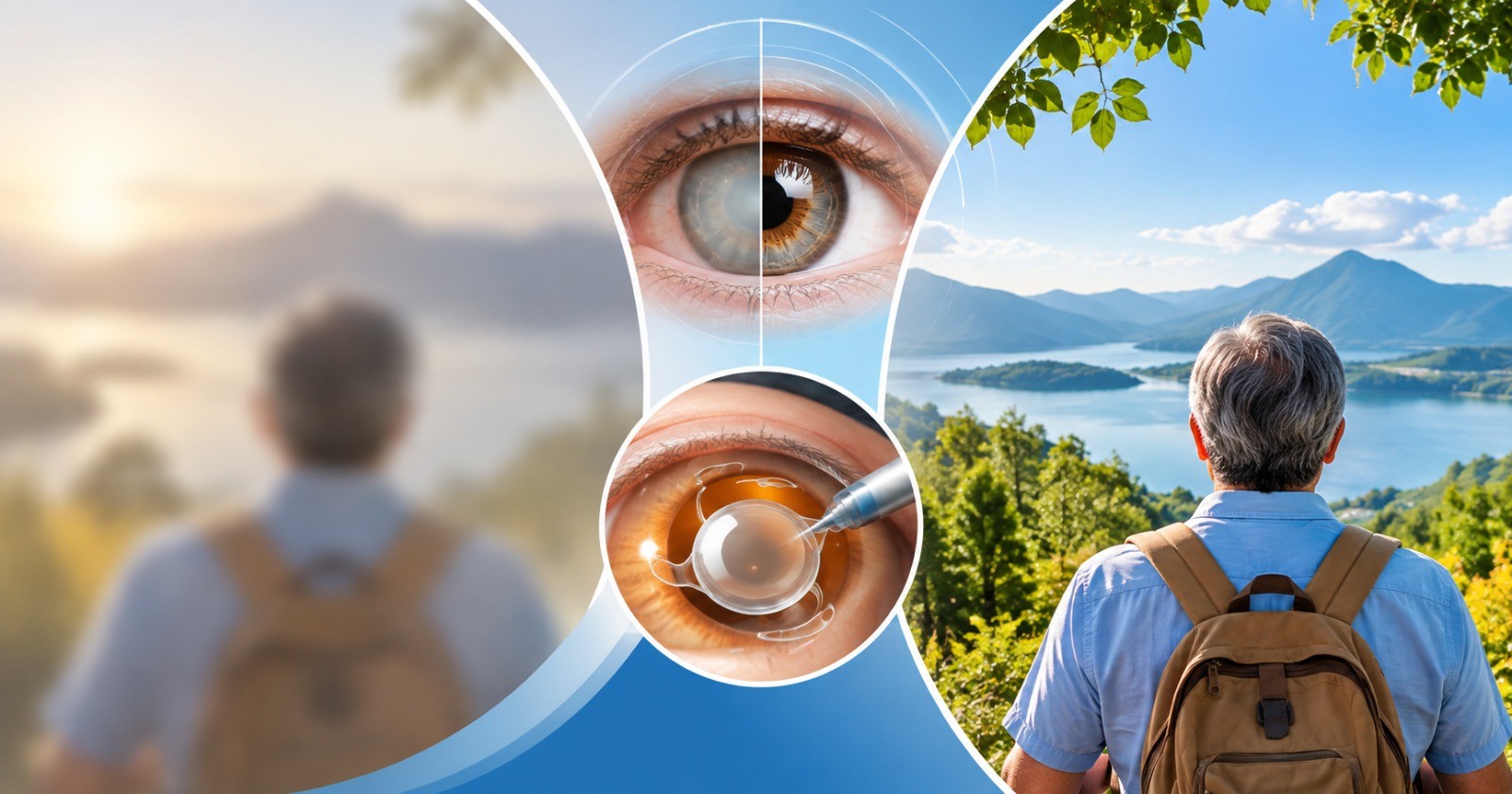
15-Minute Miracle to See the World Again: Why Cataract Surgery Is Safe, Simple, and Truly Life-Changing
If you're over 50, some of this might sound familiar. Colors don't look quite as vivid as they used to. Headlights on the highway seem to bloom into halos. Reading a restaurant menu takes longer than it should, and spotting a friend across the street suddenly feels harder than it used to be.
Most people chalk this up to "just getting older," tired eyes, or bad lighting. As the Best Ophthalmologist in Thane, I see this story play out almost every week in my clinic — and more often than not, the real cause is a cataract. The good news? It's one of the most treatable conditions in all of medicine.
What Exactly Is a Cataract?
Think of the natural lens inside your eye as a clear window. Over the years, the proteins in that lens can start to clump together, clouding it up — a bit like a window slowly frosting over. That's a cataract. It's not an infection, not a growth, and not something you "caught." It's simply a natural part of aging, though diabetes, long-term sun exposure, smoking, steroid use, and past eye injuries can speed things along.
Here's the part patients are often surprised to hear: no drops, supplements, or exercises can reverse a cataract. Surgery is the only real fix — and thankfully, it's one of the safest, most refined procedures we perform today.
A few things that make this surgery stand out:
As with any surgical procedure, there's no such thing as zero risk — but for the vast majority of patients, living with declining vision is riskier than treating it.
Convenient — It's a day-care procedure; you go home the same day.
Quick — Surgery typically takes 10 to 20 minutes per eye.
Virtually painless — Numbing drops or local anesthesia keep you comfortable. You might feel slight pressure or notice moving light, but injections for anesthesia are now rarely needed.
Fast recovery — Many patients notice sharper vision within a day or two and are back to light activity almost immediately. Aftercare is simple: prescribed eye drops, a protective shield at night, and avoiding rubbing your eye or heavy strain for a short while. If both eyes need treatment, we usually space the two surgeries a week or two apart, so you're never left without functional vision in between.
It's Safe — And Backed by Decades of Refinement
Cataract surgery is among the most frequently performed procedures worldwide, with success rates north of 98%. Most surgeons, myself included, use a technique called phacoemulsification. Through an incision smaller than 3mm, we use a gentle ultrasonic probe to break up the clouded lens and remove it. A clear artificial lens — an intraocular lens (IOL) — is then placed exactly where your natural lens used to sit, and it stays there for life.
- High success rates — Most patients without other underlying eye conditions see a dramatic improvement in vision.
- Low complication rates — Serious complications are rare, and issues like temporary inflammation or swelling are usually easy to manage.
- Tiny incisions, quick healing — The wound is small enough that it often seals on its own, no stitches needed.
- Careful pre-surgical screening — Before we operate, we measure your eye precisely and review your medical history so we can recommend the lens best suited to your lifestyle.
As with any surgical procedure, there's no such thing as zero risk — but for the vast majority of patients, living with declining vision is riskier than treating it.
- Convenient — It's a day-care procedure; you go home the same day.
- Quick — Surgery typically takes 10 to 20 minutes per eye.
- Virtually painless — Numbing drops or local anesthesia keep you comfortable. You might feel slight pressure or notice moving light, but injections for anesthesia are now rarely needed.
- Fast recovery — Many patients notice sharper vision within a day or two and are back to light activity almost immediately. Aftercare is simple: prescribed eye drops, a protective shield at night, and avoiding rubbing your eye or heavy strain for a short while. If both eyes need treatment, we usually space the two surgeries a week or two apart, so you're never left without functional vision in between.
More Than Clearer Vision — It's Life-Changing
Almost every patient tells me the same thing after surgery: "I had no idea how much I was missing."
Colors come back brighter. Driving at night feels safer. And because clearer vision significantly reduces the risk of falls — one of the leading causes of injury in older adults — day-to-day independence improves in ways patients don't always expect.
- Independence returns. Reading, cooking, using your phone, recognizing faces from across a room — all of it gets easier.
- Confidence and mood lift. Poor vision has a quiet way of pulling people away from hobbies and social life. Restoring sight often restores enthusiasm for living.
- Lens options for your lifestyle. Modern IOLs aren't one-size-fits-all. Depending on your needs, we can choose lenses that correct astigmatism, reduce your dependence on glasses, or focus purely on clear distance vision.
When Should You See an Eye Doctor?
- You don't have to wait until your vision is badly affected. Book an eye exam if you're noticing:
- Blurry, cloudy, or "foggy" vision
- Glare or halos around lights, especially while driving at night
- Colors that look dull or yellowed
- Glasses prescriptions that keep changing
- Trouble reading or seeing clearly in dim light
An eye exam can confirm whether it's a cataract, and whether it's the right time to consider surgery.
The Bottom Line?
Cataracts are a natural part of aging — but living with blurry, faded vision doesn't have to be. With a safe, quick, and highly effective procedure, you can reclaim clear sight and, with it, your independence, confidence, and everyday joy.
As a Consultant Ophthalmologist with over 23 years of experience in cataract and glaucoma care, I also see patients for LASIK, diabetic eye care, and other areas of comprehensive eye treatment at KIMS Hospitals, where we have advanced equipment and a full range of lens options to match every lifestyle and need.
Consult Dr. Rashmi Barve for a personalized eye check-up: https://www.kimshospitals.com/doctor-profile/dr-rashmi-barve/
Footer Loading...