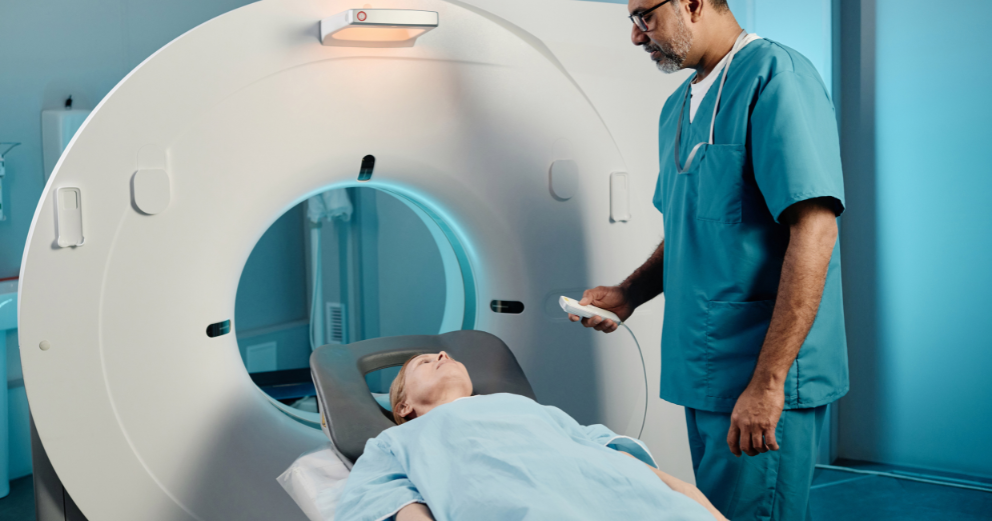
Are Repeated Scans Harmful?
Imaging tests have become a routine part of medical care. CT scans, X-rays, and related investigations are ordered across a wide range of conditions, and for patients managing chronic illnesses or undergoing cancer treatment, repeat imaging over months and years is not unusual. This raises a reasonable question: does all that radiation add up and when should it become a concern?
The answer depends significantly on which type of imaging is involved, how frequently it is being done, the body part being scanned, the patient’s age, and the clinical reason for the scan.
Not all scans involve radiation
This is the first distinction worth understanding clearly. MRI and ultrasound do not use ionising radiation. MRI works through magnetic fields and radio waves, while ultrasound uses sound waves. Repeated MRI or ultrasound examinations do not add to cumulative ionising-radiation dose.
However, this does not mean that every scan should be done without reason. MRI still requires implant and metal screening, and contrast safety checks when gadolinium is used. Ultrasound is very safe, but it may not answer every clinical question. Concerns about cumulative radiation exposure apply specifically to CT scans, X-rays, mammography, fluoroscopy and nuclear medicine studies, which use ionising radiation.
How does CT scan radiation work?
A single CT scan delivers a small, carefully controlled dose of ionising radiation. At diagnostic dose levels, CT does not usually cause immediate tissue injury.
The concern is not usually one appropriately justified CT scan. The concern is cumulative dose from repeated or duplicated CT scans over time, especially when the scans are high-dose studies or when the clinical reason is unclear. Risk depends on the patient’s age, the body region scanned, the CT protocol, the dose delivered, and the benefit expected from the result.
This risk is not the same as a guarantee. No individual CT scan can be said to cause cancer in a predictable or direct way. The concern is probabilistic, meaning that the higher the cumulative dose over a lifetime, the higher the statistical likelihood of harm at a population level.
Who carries the highest risk?
Children are the most vulnerable group when it comes to cumulative radiation exposure. Their tissues are growing rapidly, their cells are dividing more actively, and they have more years ahead of them during which any radiation-related effect could manifest. A dose that carries low risk for a 60-year-old carries a proportionally higher risk for a child receiving the same scan.
Beyond children, certain groups warrant particular attention:
- Patients with chronic conditions such as inflammatory bowel disease, kidney stone disease, or certain cancers who require regular CT-based monitoring over many years
- Young adults who begin accumulating imaging doses early in life
- Pregnant patients, especially when the abdomen or pelvis may be exposed, require special justification and protocol optimisation. However, necessary imaging should not be withheld if it is clinically important.
- Patients who have received imaging at multiple hospitals without a consolidated record of prior exposure
- Anyone being referred for imaging without a clearly defined clinical reason
The principle guiding safe imaging practice
Radiologists follow a principle called ALARA, which stands for As Low As Reasonably Achievable. In practice, safe imaging has two parts: justification and optimisation. The scan should have a clear clinical purpose and the dose should be tailored to produce diagnostic images without unnecessary exposure.
In practice, this means:
- Adjusting the dose to the patient's body size and the specific clinical question being asked
- Choosing MRI or ultrasound when either can answer the clinical question as effectively as CT
- Using low-dose CT protocols when appropriate, for example in selected kidney stone follow-up or lung nodule surveillance
- Limiting the scanned area to the region that actually needs assessment
- Avoiding repeat imaging when a recent scan already exists and the clinical situation has not changed
- Ensuring every scan ordered has a clear and specific clinical purpose
When the benefit clearly outweighs the risk
It is equally important not to overstate the concern to the point where it causes hesitation about necessary scans. A CT scan that identifies a stroke, a pulmonary embolism, internal bleeding after trauma, or a cancer at an early stage delivers a benefit that far outweighs the small statistical radiation risk it carries.
The problem is not CT scanning itself. It is unnecessary or duplicated scanning without clinical justification, particularly in populations that are more sensitive to radiation. Avoiding a genuinely needed scan because of radiation concern can itself be dangerous. The decision always involves weighing the benefit of the information against the dose involved.
What patients can do
Patients who have had multiple imaging studies, particularly across different hospitals or over several years, can take a few practical steps to manage their cumulative radiation exposure:
- Keep a personal record of imaging studies received, including the date, facility, and type of scan
- Carry or share previous reports and images, preferably through a CD, DICOM link, hospital portal, or cloud link, so that unnecessary repeat scans can be avoided
- Ask the treating doctor whether a new scan is necessary given recent imaging, and whether a radiation-free alternative would answer the same question
- Inform each new doctor or specialist about prior imaging history, especially for children
- For ongoing conditions requiring regular monitoring, ask whether the scanning interval can be extended safely once the condition has stabilised
- Do not refuse a necessary CT scan only because of radiation fear; instead, ask why it is needed and whether the protocol can be optimised.
Takeaways
Repeated scans are not automatically harmful, and not all scans involve radiation. MRI and ultrasound do not add to cumulative ionising-radiation dose. CT scans and X-rays do add dose, but the risk from a medically justified scan is usually small and must be balanced against the benefit of diagnosis.
The safest approach is not to avoid CT blindly, but to avoid unnecessary or duplicated CT scans. Medical imaging safety depends on three things: every scan should be justified, the dose should be optimised, and radiation-free alternatives should be used when they can answer the question equally well.