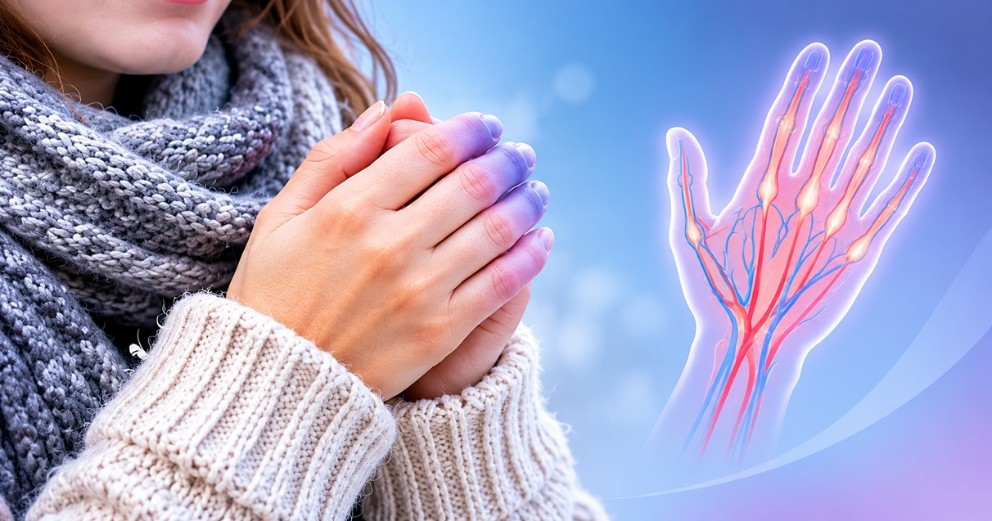
Fingers Turning White or Blue in Cold Weather — And What It Could Mean
Most people notice their hands getting cold in winter. The fingers feel stiff, the skin tightens, and warmth returns the moment they step indoors or wrap their hands around a cup of tea. This is unremarkable. But for a subset of people, cold exposure triggers something distinctly different, a dramatic colour change in the fingers, sometimes the toes, and occasionally the ears or nose, where the skin turns white, then blue, then red as blood flow returns. The sequence is characteristic, the discomfort is real, and for many people, it goes undiagnosed for years.
This is Raynaud's phenomenon, and while it is often benign, it is not always. Knowing when it is simply a vasospastic quirk and when it is signalling something more significant underneath is clinically important.
What Actually Happens During an Episode
To understand Raynaud's phenomenon, it helps to understand what the blood vessels in the fingers are doing. Normally, cold exposure causes a moderate constriction of peripheral blood vessels to conserve core body temperature. In Raynaud's, this response is exaggerated. The small arteries supplying the fingers go into sudden, severe spasm, dramatically reducing or temporarily cutting off blood flow to the affected digits.
The colour sequence that results is almost diagnostic on its own. The fingers first turn white as blood drains away. They then turn blue as the oxygen in the residual blood is consumed and deoxygenated haemoglobin accumulates. When the spasm releases and blood rushes back in, the fingers turn red, often accompanied by a burning, tingling sensation that can be quite uncomfortable.
Primary vs Secondary Raynaud's — Why the Distinction Matters
This is where the clinical picture becomes more important than the symptom itself.
Primary Raynaud's
It is also called Raynaud's disease, occurs without any underlying condition. It tends to affect younger women, often beginning in the teens or twenties, and while the episodes can be uncomfortable and disruptive, they do not cause tissue damage and are not associated with progressive disease. The colour changes are symmetrical, affecting multiple fingers on both hands, and there are no other associated symptoms.
Secondary Raynaud's
It is also called Raynaud's phenomenon, occurs as a manifestation of an underlying condition, most commonly an autoimmune or connective tissue disease. This distinction matters enormously because secondary Raynaud's can be the first sign of a disease that will require specialist management, and because secondary Raynaud's carries a risk of digital ulcers and, in severe cases, tissue damage that primary Raynaud's does not.
Conditions most commonly associated with secondary Raynaud's include:
- Systemic sclerosis (scleroderma) - Raynaud's is present in over 90% of patients with this condition and frequently precedes other manifestations by years
- Systemic lupus erythematosus - where Raynaud's occurs alongside joint pain, fatigue, and skin changes
- Sjögren's syndrome - associated with dryness of the eyes and mouth alongside Raynaud's
- Rheumatoid arthritis - where Raynaud's can accompany the joint disease
- Dermatomyositis and mixed connective tissue disease
- Hypothyroidism - an underactive thyroid can cause or worsen vasospasm
- Certain medications - including beta-blockers, migraine medications containing ergotamine, and some chemotherapy agents
Features That Suggest Secondary Rather Than Primary Raynaud's
Not every person with cold fingers turning white or blue has an underlying autoimmune condition. But certain features shift the probability considerably toward secondary disease and warrant investigation:
- Onset after the age of 30, particularly in someone without a longstanding history
- Asymmetric involvement, or episodes affecting only one or two fingers rather than multiple digits on both hands
- Severe episodes causing pain, ulceration, or slow-healing sores at the fingertips
- Associated symptoms including joint pain, skin thickening, dry eyes or mouth, persistent fatigue, or rashes
- Abnormal nailfold capillaroscopy findings, a simple, non-invasive examination using a magnifying instrument to look at the tiny blood vessels at the base of the nails, which show characteristic changes in systemic sclerosis and other connective tissue diseases
- Positive autoimmune blood tests including ANA, anti-Scl-70, or anti-centromere antibodies
How Raynaud's Is Investigated
The initial assessment for someone presenting with Raynaud's symptoms covers a detailed clinical history including the pattern, duration, and triggers of episodes, a review of medications, a family history of autoimmune disease, and a targeted examination looking for the signs of associated conditions.
Blood investigations typically include a full blood count, inflammatory markers, thyroid function tests, and an ANA screen with reflex testing for specific antibodies. Nailfold capillaroscopy is a valuable early investigation that can identify the capillary changes of systemic sclerosis even before other features of the disease have appeared.
Management Of The Condition
For primary Raynaud's disease, management is largely lifestyle-based. Keeping the whole body warm rather than just the hands, layering clothing, wearing insulated gloves when going outdoors or handling cold items from the refrigerator, avoiding sudden temperature changes, and stopping smoking, which causes its own vasospasm, are the foundations. Chemical hand warmers and electrically heated gloves have genuine utility for patients with frequent or severe episodes.
For secondary Raynaud's, treatment addresses both the vasospasm and the underlying disease. Patients with systemic sclerosis and severe Raynaud's causing digital ulcers may require additional vasodilatory treatment with phosphodiesterase inhibitors or prostanoid infusions, alongside the disease-modifying treatment for the underlying condition.
When to Seek Assessment
Fingers turning white or blue in cold weather is not always a reason for concern, but it is always a reason for at least a brief clinical assessment when it is a new or worsening symptom. The questions worth asking are whether the colour change follows the classic three-phase sequence, whether it is getting more frequent or more severe, and whether any other symptoms are accompanying it.
For people in whom the Raynaud's phenomenon is longstanding, mild, and entirely consistent with primary disease, reassurance and lifestyle advice is often all that is needed. For those with features suggesting secondary disease, early investigation and specialist review is what gives the best opportunity to identify and treat the underlying condition before it progresses.