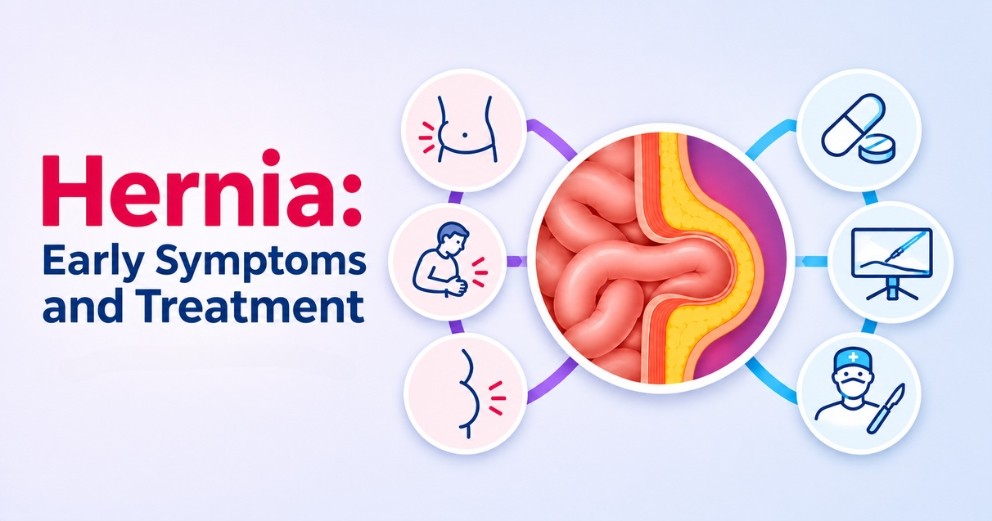
Hernia: Early Symptoms and Treatment
A hernia tends to make itself known in the most inconvenient way. Lifting something heavy, straining during a bowel movement, or even just coughing, and suddenly there is a bulge where there was none before, often accompanied by discomfort that was not there yesterday. For many people, the initial response is to ignore it and hope it resolves on its own. It will not. Hernias do not heal without treatment, and while many remain manageable for a period, all carry the risk of complications if left unaddressed indefinitely.
Understanding what a hernia is, how to recognise it early, and what the treatment options involve helps people make timely decisions rather than delayed ones.
What a hernia actually is
A hernia occurs when an organ or tissue pushes through a weakness in the peritoneum, the muscular wall that usually keeps abdominal organs in place, creating a bulge that may cause discomfort or pain.
The mechanism is similar to what happens with a bulge in a damaged tyre, where the inner tube, normally contained by the hard rubber, extends through a thin or weakened place in the tyre wall. The opening in the abdominal wall through which tissue protrudes is called the hernia defect, and the visible or palpable result is the hernia itself.
Common types of hernia
Common types of hernia include inguinal, femoral, hiatal, umbilical, and incisional hernias.
- Inguinal hernia is the most common type, occurring when tissue, often part of the intestine, pushes through a weak spot in the abdominal muscles near the groin. Between 10 and 15% of men and 2% of women will develop inguinal hernias in their lifetime. They are more common in men because of anatomical differences in the inguinal canal
- Umbilical hernia occurs when tissue pushes through the abdominal wall near the belly button. It is common in infants but also affects adults, particularly those who are overweight or have had multiple pregnancies
- Incisional hernia develops at the site of a previous surgical scar, where the abdominal wall is weaker. They are a recognised complication of abdominal surgery
- Hiatal hernia occurs when part of the stomach pushes up through the diaphragm into the chest cavity. Unlike other hernias, it does not produce a visible bulge but causes symptoms related to acid reflux and swallowing
- Femoral hernia is less common and occurs just below the inguinal region, and is more frequent in women. It carries a higher risk of complications than inguinal hernias
Early hernia symptoms to recognise
A hernia usually happens in the abdomen or groin. It may look like an odd bulge that comes and goes during different activities or positions. It may or may not cause symptoms such as discomfort or pain.
The initial signs that need medical evaluation include:
- A swelling in the groin, abdomen or area around the belly button that is noticeable or felt during straining, coughing or standing up and may go away when lying down
- Painful, pulling, or lugging feeling of the groin, especially at the end of the day or after long standing
- Pain or discomfort that increases when bending, coughing or lifting up
- In men, pain or swelling of the testicles in the case of a hernia extending to the scrotum
- In case of a hiatal hernia, one experiences heartburn, regurgitation, chest pain and difficulty in swallowing.
Other hernias are totally asymptomatic and are identified during a routine physical examination or imaging performed due to another condition. Being symptom-free is no guarantee that the hernia is not there or that it does not need to be monitored.
When a hernia becomes an emergency
The most serious complication of a hernia is strangulation, where the blood supply to the trapped tissue is cut off. Hernia strangulation is a health emergency that must be surgically intervened upon.
Symptoms that reveal that a hernia has been incarcerated or strangled and is in need of emergency treatment include:
- A hernia protrusion that all of a sudden is unable to be pushed back and becomes lumpy and sore
- Severe pain that is rapidly worsening
- The pain is accompanied by nausea and vomiting
- Redness or discolouration of the skin over the hernia
- Fever, as well as the above symptoms
Hernia treatment options
The possible hernia treatment options include watchful waiting in mild cases and surgery in severe cases. They are open and laparoscopic surgery procedures, both with their own advantages and disadvantages.
Watchful waiting
For small, asymptomatic inguinal hernias in men with no complications, a period of watchful waiting with regular monitoring may be appropriate after discussion with a surgeon. This is not indefinite deferral. It is a supervised approach for carefully selected patients. Women with groin hernias are generally recommended to undergo surgical repair sooner, as the risk of complications is higher.
Surgical repair
Most hernias eventually will need surgical repair. Two main approaches are used:
- Laparoscopic repair uses small incisions, a camera, and surgical instruments to repair the hernia defect from inside the abdomen. The average abdominal wall hernia abnormality takes four to eight weeks to recover, but mainly depends on the size and complexity of the repair.
- Robotic-assisted repair is a development of laparoscopic surgery, which is more precise and has access to deep or complex hernias.
- Synthetic mesh is placed in most surgical repairs to strengthen the weakened wall of the abdomen and prevent recurrence. The aim of any method is to repair the hernia defect at the lowest level of tension to avoid the recurrence of the hernia.
Takeaways
Hernia symptoms, such as a visible bulge, pain in the groin, and dragging heaviness, are a medical issue that requires medical evaluation instead of home-based watchful waiting. The location, risk, and urgency of hernias vary greatly, with more space between the hernia and the vena cava signalling a higher risk of embolism and a greater need for hernia surgery due to strangulation.
Hernias are untreatable and may lead to severe complications when left untreated. The treatment options for a hernia include monitored observation in case of small, symptomless hernias or laparoscopic or open surgery, which is the ultimate treatment. Anyone who notices a new swelling or persistent pain in the groin or abdomen is advised to consult a surgeon promptly rather than wait.