Laryngology is a gateway to an entirely different world—especially for people whose voice is an essential part of what they do.
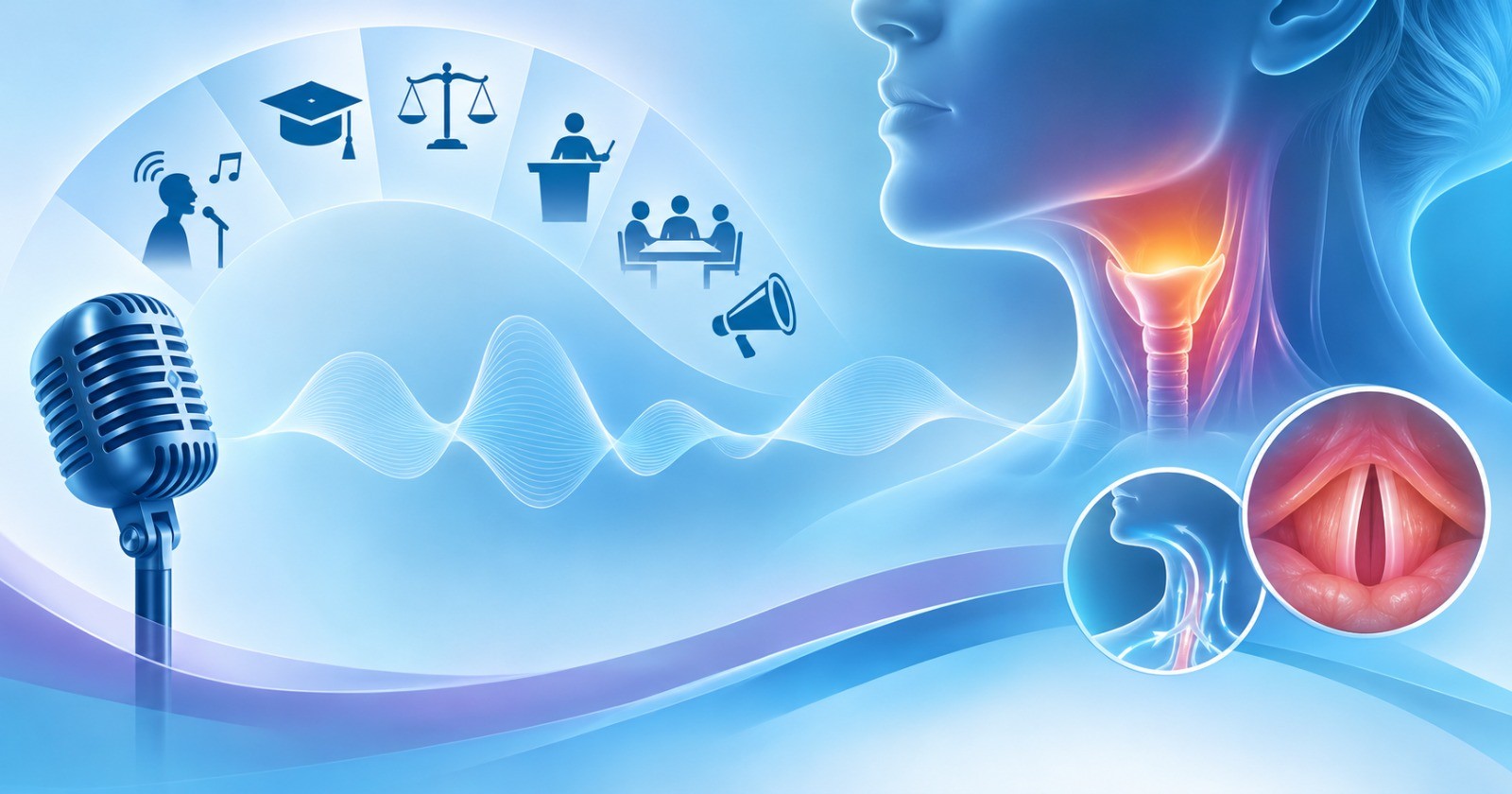
When we think of voice professionals, we immediately think of singers and actors. But the world of professional voice users is much larger. It includes teachers, broadcasters, media professionals, lawyers, CEOs, marketing professionals, public speakers—and, in reality, almost anyone whose ability to communicate effectively affects their work and daily life.
From a young mother raising her voice over her children to a CEO running an important board meeting, our voices are constantly at work.
Some people use their voices professionally in ways that demand far more than ordinary conversation. When the ability to use that voice is affected, their work, performance, confidence and sometimes even their identity can be affected.
We often call such individuals vocal athletes.
Just as a sprinter trains their body to perform at its maximum capacity, a vocal athlete trains and uses the vocal mechanism to its fullest potential. A singer may need to reach demanding notes. A teacher may speak continuously for hours. An actor may need to shout, whisper, sing and perform emotionally. A broadcaster must maintain consistency and clarity. A lawyer may need to project their voice throughout an entire day.
The vocal folds are expected to perform at an extraordinary level.
And this is where the science of Laryngology comes in.
Today, it is possible to prevent, diagnose and treat a wide range of voice disorders using multiple modalities—including voice therapy, injections, minimally invasive procedures and surgery.
It is often said that a person’s voice is their second face.
We are all familiar with aesthetic procedures for the face—Botox, fillers and other treatments that help us look and feel the way we want to. But imagine if we could apply the same level of precision and specialised care to the voice.
Imagine being able to understand exactly why your voice is not performing the way you want it to.
And that is exactly what modern Laryngology allows us to do.
With a stroboscope, we can observe the vocal folds during phonation in slow motion. We can analyse their vibration and identify subtle abnormalities that may not be visible during a routine examination. This allows us to pinpoint the exact cause of a patient’s symptoms and understand why they may be unable to use their voice the way they want to.
Whether it is:
- Hoarseness of voice
- A voice that has become unusually low-pitched or high-pitched
- Difficulty singing particular notes
- Loss of vocal range
- Voice fatigue
- Inability to project the voice
- Difficulty sustaining the voice through a performance or working day
—many of these problems can now be precisely evaluated and appropriately treated.
But Laryngology is not just about singers and professional performers.
Have you ever experienced that persistent feeling that something is stuck in your throat?
Or a cough that simply does not seem to go away?
That constant lump-in-the-throat sensation?
The repeated need to clear your throat?
Many patients have visited multiple doctors without receiving a clear explanation or a concrete solution. Sometimes, the answer lies in the larynx and the upper airway.
Laryngology also extends far beyond voice.
From swallowing difficulties in elderly patients to chronic throat symptoms in younger individuals, the field deals with a wide range of conditions involving voice, airway and swallowing.
And the field is evolving rapidly.
With the advent of Narrow Band Imaging (NBI), we can examine the larynx under specialised light and identify abnormal vascular patterns and suspicious areas that may require further evaluation.
This is particularly important in individuals at higher risk of head and neck cancers, including smokers and those with significant environmental exposures.
Early identification of suspicious lesions can play a crucial role in the timely diagnosis and appropriate management of laryngeal and head-and-neck cancers.
Laryngology today is therefore much more than simply treating a hoarse voice.
It is about preserving communication.
It is about helping a singer return to the stage, a teacher return to the classroom, a lawyer argue their case, a broadcaster return to the microphone and an elderly patient swallow safely.
Because when the voice is someone’s profession, their identity or their connection with the world, restoring it can mean restoring so much more than just sound.
Your voice is not just something you have.
For many people, it is what they do.
And sometimes, protecting that voice requires a completely different world of medicine.
Written by
Associate Consultant Laryngologist at KIMS Hospitals, Thane
Footer Loading...