More But Not Merrier? Smiling All the Way.
- Dr Srinivas L, Chief & Senior Interventional Pediatric Cardiologist
A 40-year-old lady, Mrs. Shilpa (name changed), a mother of three healthy children, arrived at our Outpatient Department (OPD) accompanied by her entire family. She had been recently diagnosed with heart disease following a routine echocardiogram. Interestingly, the family seemed remarkably comfortable with the diagnosis and had come to us specifically for the device closure of an Atrial Septal Defect (ASD).
While Shilpa was being positioned for a repeat echocardiogram, I started a conversation with her mother-in-law, who was sitting on a chair with a smiling face and an abundance of confidence. Within the first few sentences, she blurted out, "Doctor saab, even I underwent an ASD device closure 15 years ago"—and as it turned out, I had probably performed the procedure myself at another hospital.
Suddenly, I knew the secret behind their confidence. I jokingly asked, "Did you choose a matching Bahuraani (daughter-in-law) with a hole in her heart?" Appreciating the humour in the question, she declared that her Bahuraani was a close blood relative. Genetics may have played a significant role, I thought.
An ASD is a defect that is present from birth, yet it goes undetected in about 30% of patients until their third or fourth decade of life. Patients who learn of this diagnosis as adults are often shocked and enter a phase of denial. I would have expected Shilpa, a mother of three, to have expressed that same shock and denial, but because of a family member's past experience, this denial was entirely absent.
Uncovering the Surprises
However, the routine nature of the visit for an ASD device closure quickly shifted. My colleague performing the echocardiogram recognized that there was more than one hole responsible for her enlarged heart. I agreed with her assessment and requested a Transesophageal Echocardiogram (TEE) for the following morning to confirm the findings and plan the device closure.
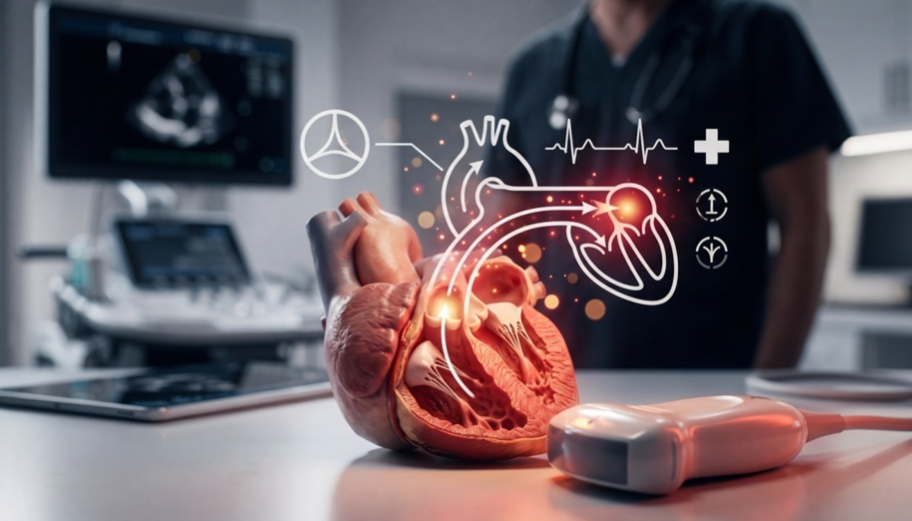
TEE is an advanced mode of echocardiography where we pass a small tube inside the patient’s esophagus (food pipe) to obtain accurate, unobstructed, close-up views of the heart from the inside. For a foolproof ASD device closure in adult patients, we always recommend this test beforehand to eliminate any surprises on the table.
The TEE revealed multiple defects in the interatrial septum (the membrane that separates the two upper chambers of the heart). We documented at least three large holes alongside multiple additional smaller defects. The ASD device closure procedure would no longer be a routine case for Mrs. Shilpa.
Fortunately, our team has extensive experience in closing multiple ASDs using transcatheter devices, and we have pioneered many safe techniques to assess such patients and execute complex plans. At KIMS Hospitals, Thane, we possess all the specialized equipment and expertise required to undertake a case of this magnitude.
For Shilpa’s family, apart from understanding the medical complexity, every additional device meant a more expensive procedure. After a thorough evaluation, we concluded that we would need a minimum of two to three devices to secure all the defects. Thankfully, detailed counseling was well-received, and gaining family consent was not a challenge.
The Procedure and a Direct Plea
We commenced the procedure the next morning with a smiling Shilpa on the cath table. She was placed under general anesthesia for the procedure, as we would depend heavily on continuous TEE imaging throughout the procedure. Utilizing small punctures for femoral venous access, we successfully accomplished the procedure using two large ASD devices. Having a three-dimensional TEE was an incredible benefit and a massive confidence booster for the operating team. The procedure went uncomplicated, and Shilpa sailed out of the cath lab smiling within two hours.
Transesophageal echocardiography has made ASD device closures in adult patients significantly more predictable and safe over the past two decades. Because of this, I strongly urge all my cardiology colleagues and adult patients themselves to insist on at least one TEE test before embarking onto an ASD device closure. It is the single best way to avoid untoward complications and surprises on the operating table. TEE is a simple, OPD-based procedure that can be comfortably performed within just 10 to 15 minutes.
"One small extra step and effort can make this procedure completely safe." This I say with confidence, after performing more than 1,500 successful ASD device closures.