Scar Treatment Options
Scars are the skin's way of repairing itself after injury. They are part of a normal healing process, whether it is from surgery, burns, acne or trauma. Scars are not just a cosmetic concern for many people. They can restrict movement, cause itching or discomfort, and affect self-confidence. Some types of scars continue to grow long after the wound has healed.
The good news is that scar treatment has advanced considerably, and there is now a meaningful range of options available depending on the type of scar and what outcome the patient is hoping for.
Understanding Different Scar Types
The treatment is not the same for every scar. It depends on the type of scar being treated.
- Flat scars are the most common ones due to wound healing. They faide over time and cause minimal problems. Many require little to no treatment other than sun protection.
- Hypertrophic scars are thick, raised and red. They stay within the boundaries of the original wound and may improve over time, but they benefit the most from early intervention.
- Keloids extend beyond the original wound boundaries and continue to grow. They are more common in people with darker skin tones. They tend to recur after removal, so they require more aggressive management.
- Atrophic scars are sunken into the skin as a result of acne or chickenpox. They reflect a loss of tissue beneath the skin's surface rather than an overgrowth.
- Contracture scars result from burns or injuries over joints and can restrict movement. They require a person to get functional rehabilitation alongside cosmetic treatment.
Non-surgical Scar Treatment Options
For many scars, non-surgical approaches form the foundation of management and can produce significant improvement without the risks associated with surgery.
Silicone
Silicone gel sheets and topical silicone gels are among the most widely used and evidence-supported options for hypertrophic scar treatment. They hydrate the scar tissue and allow collagen production. They work best when started early in the healing process and applied daily for months.
Compression Therapy
Custom-fitted compression garments are worn for more than a year to address burn and hypertrophic scars over large areas. The constant pressure reduces the thickness and raised profile of the scar as time goes by. This is standard practice in burn rehabilitation and is started as soon as the wound has sufficiently healed.
Corticosteroid Injections
Injections directly into the scar reduce inflammation and flatten raised, thickened scar tissue. They are commonly used for both hypertrophic scars and keloids and are often given in a series of sessions spaced weeks apart. Keloid treatment frequently combines injections with other approaches because keloids have a high tendency to recur with single-modality treatment.
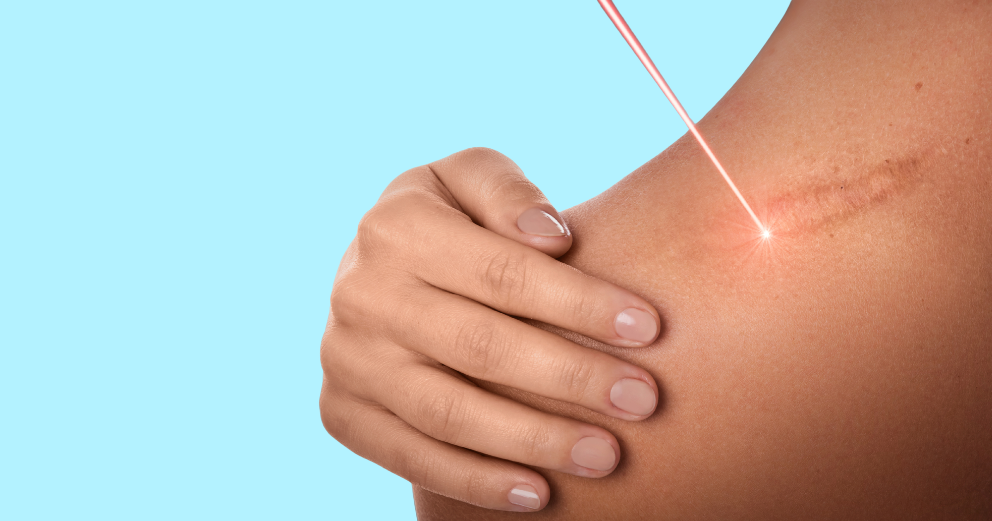
Laser Scar Removal
Laser treatment works best as part of a treatment plan. They can provide aesthetic improvements to scar texture, colour, and thickness.
- Vascular lasers treat the redness associated with hypertrophic and immature scars by reducing blood vessel density within the scars.
- Fractional CO2 and Erbium lasers resurface the skin and stimulate collagen production to improve the texture and depth of atrophic and hypertrophic scars.
- Ablative and non-ablative lasers improve scar appearance. The fractional CO2 laser shows improvements in atrophic scars.
There may be multiple sessions for laser scar removal, and the results depend on factors like scar age, type, and skin tone.
Microneedling
Microneedling creates micro-injuries in the skin that make the body produce more collagen. It is recommended for atrophic acne scars and can be combined with platelet-rich plasma therapy to get the desired results. It is well tolerated and suitable across a range of skin tones with appropriate settings.
Surgical Scar Treatment Options
When non-surgical measures have not produced sufficient improvement, or when a scar is causing functional restriction, surgical intervention becomes the next step.
- Scar revision involves surgically excising the scar and reclosing the wound under more controlled conditions. It produces a flatter, less noticeable scar. It works best for irregularly healed scars.
- Z-plasty and W-plasty are surgical techniques that reorient a scar across tension lines, thereby reducing its visibility and improving the range of motion in contracture scars.
- Skin grafting and flap surgery are used for large or complex scars, burn contractures, and other conditions in which a large area needs to be covered to restore function.
- Subcision involves inserting a needle beneath atrophic scars to release the fibrous bands that tether them to deeper tissue. It makes the surface rise and improves the scar's appearance.
- Nanofat grafting is a newer regenerative technique that uses the patient's own fat tissue, processed into a fine emulsion, to improve scar quality. Fat is harvested through liposuction, mechanically broken down into a "nanofat" consistency, and then injected into and beneath the scar.
Scar treatments use multiple methods tailored to the scar type, location, and patient profile.
What Affects How Well a Scar Responds
There are many factors to consider when it comes to a scar's response to treatment.
- Scar age: Newer scars are more responsive to treatment than older ones.
- Skin tone: Some treatments carry a higher risk of pigmentation changes in darker skin tones, so they require parameter adjustments.
- Scar type: Keloids are harder to treat and require a combination of treatments to improve their appearance.
- Patient compliance: Patients need to use compression therapy and silicone gel for months to see results.
Takeaways
Scar treatment options are many, ranging from conservative measures to surgical intervention. Silicone and laser therapy are the hypertrophic scar treatments for new scars. Keloid treatment requires a combination of approaches due to its high recurrence rate.
Fractional laser and microneedling are the best treatment options for acne-related atrophic scars. But the right plan depends on the type of scar, its location, and the patient's needs. It is best to consult a dermatologist or plastic surgeon experienced in scar management.