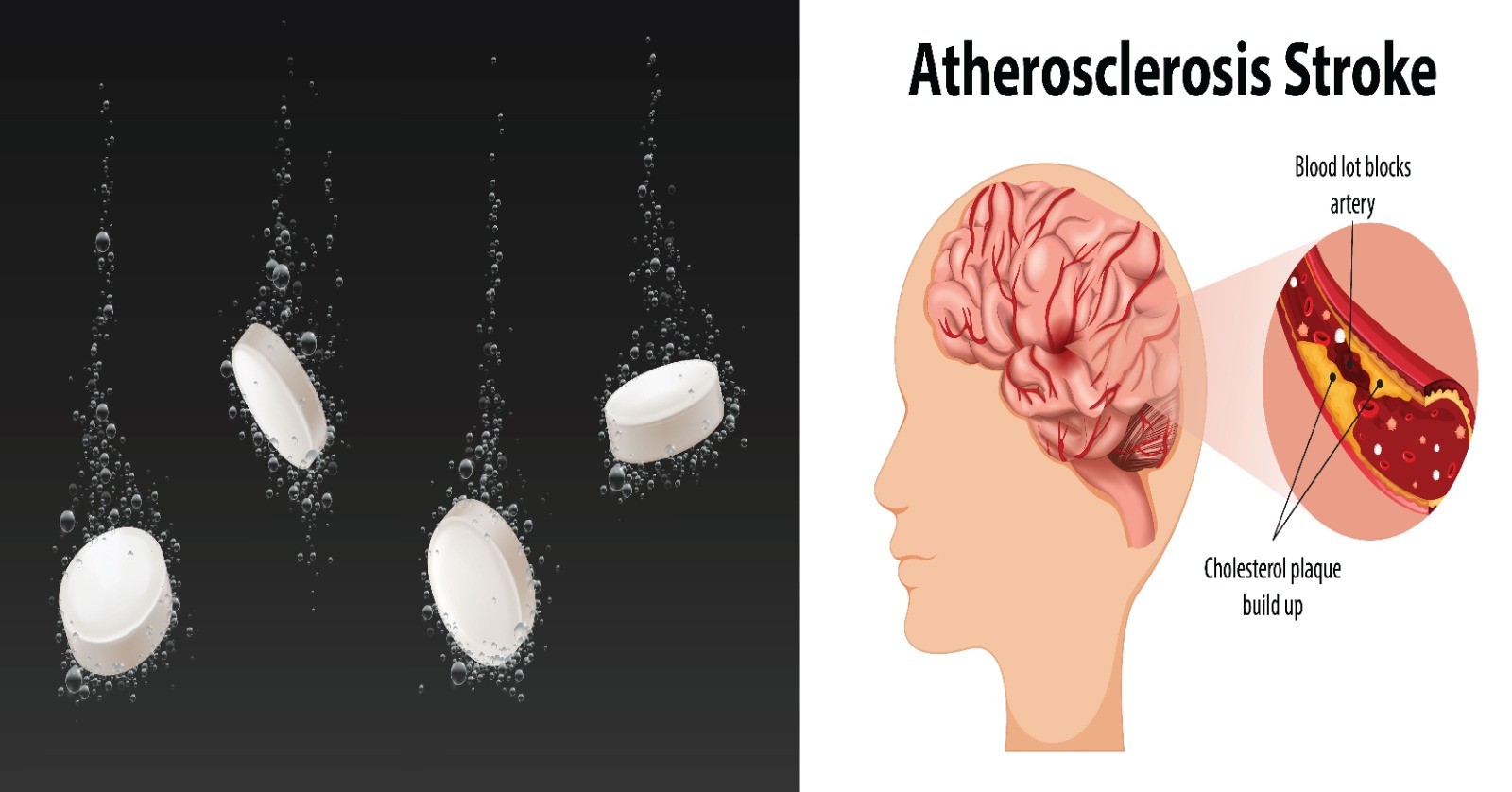
WHY DO SOME PEOPLE HAVE A STROKE DESPITE TAKING ASPIRIN?
Because aspirin reduces risk—but it does not make you stroke-proof
“I was taking aspirin every day. Then how did I still get a stroke?”
It is one of the most understandable questions a patient or family member asks after a stroke.
And the answer is important:
Aspirin is not a shield against every type of stroke.
It reduces the risk of certain strokes, but it does not eliminate the risk—and in some situations, aspirin may not even be the right preventive treatment.
FIRST, WHAT DOES ASPIRIN ACTUALLY DO?
Aspirin is an antiplatelet drug.
Platelets are tiny blood cells that help form clots.
When an atherosclerotic artery becomes damaged or develops a ruptured plaque, platelets can become activated and contribute to clot formation.
Aspirin interferes with platelet activation.
So, in appropriate patients, aspirin can reduce the likelihood of a clot forming on an atherosclerotic arterial plaque and travelling to the brain.
But notice what aspirin does not do.
It does not:
- Remove cholesterol plaques
- Open a severely narrowed artery
- Dissolve every blood clot
- Prevent atrial fibrillation
- Control blood pressure
- Control diabetes
- Stop every mechanism of stroke
And therefore:
Taking aspirin does not mean that a stroke is impossible.
NOT ALL STROKES ARE CAUSED BY THE SAME THING
This is perhaps the most important concept.
We use the word “stroke” as though it represents one disease.
It doesn’t.
An ischemic stroke can occur through several mechanisms.
For example:
Atherosclerotic disease
A clot may form on diseased arteries.
Aspirin can be useful in appropriate patients with this type of vascular disease.
Atrial fibrillation
The irregular heartbeat can allow blood to stagnate in the atria, particularly the left atrial appendage, leading to clot formation.
That clot can then travel to the brain.
For appropriate patients with atrial fibrillation, anticoagulation—not aspirin—is generally the more effective strategy for prevention of cardioembolic stroke.
So a patient with undiagnosed atrial fibrillation may take aspirin faithfully and still suffer an embolic stroke.
The problem wasn’t that the patient “failed aspirin.”
Small-vessel disease
Long-standing hypertension and diabetes can damage the tiny arteries supplying the brain.
These strokes are not simply caused by a platelet-rich clot sitting on a large artery.
Controlling the underlying vascular risk factors is crucial.
Other mechanisms
There are also strokes related to:
- Arterial dissection
- Unusual clotting disorders
- Vasculitis
- Certain genetic disorders
- Paradoxical embolism
- Other less common mechanisms
The treatment must therefore be tailored to the cause.
“BUT I NEVER MISSED MY ASPIRIN.”
That is important.
But adherence is only one part of prevention.
Imagine wearing a seat belt while driving a car with completely worn-out brakes.
The seat belt is useful.
But it doesn’t eliminate every danger.
Similarly, aspirin may reduce one component of vascular risk while other major risks remain uncontrolled.
A person taking aspirin but having a BP of 170/100, continuing to smoke, having uncontrolled diabetes and very high LDL cholesterol is not adequately protected from stroke simply because aspirin is being taken.
BLOOD PRESSURE MAY MATTER MORE THAN THE ASPIRIN
One of the most powerful modifiable risk factors for stroke is hypertension.
And it is often silent.
A person may faithfully take aspirin every morning while their BP remains persistently elevated.
That is not adequate stroke prevention.
Stroke prevention is not a single-pill strategy.
It is a strategy involving:
Blood pressure + cholesterol + diabetes + smoking + exercise + diet + appropriate antithrombotic therapy + treatment of the underlying stroke mechanism.
WHAT ABOUT CHOLESTEROL?
Aspirin does not lower LDL cholesterol.
If atherosclerosis is contributing to stroke risk, cholesterol management becomes an important part of prevention.
Statins and other lipid-lowering treatments can reduce vascular risk in appropriately selected patients.
So:
“I’m taking aspirin, therefore I don’t need a statin.”
is a dangerous misunderstanding.
They do different jobs.
WHAT ABOUT SMOKING?
Aspirin does not cancel out the vascular effects of smoking.
Smoking damages the lining of blood vessels, promotes atherosclerosis and increases thrombotic risk.
You cannot smoke a pack of cigarettes and then consider the vascular damage “covered” because you took an aspirin.
There is no pill that neutralises smoking.
WHAT ABOUT DIABETES?
Persistently elevated blood glucose damages blood vessels over time and contributes to atherosclerosis and small-vessel disease.
Aspirin cannot compensate for poorly controlled diabetes.
Good stroke prevention therefore requires managing the entire vascular risk profile.
SOMETIMES THE PROBLEM IS NOT ASPIRIN—IT IS THE WRONG DRUG FOR THE MECHANISM
This distinction is crucial.
Antiplatelets
Such as aspirin are primarily used for prevention in certain non-cardioembolic ischemic stroke mechanisms.
Anticoagulants
Such as direct oral anticoagulants or warfarin are used in selected conditions where the stroke mechanism is related to abnormal coagulation, particularly atrial fibrillation.
They are not interchangeable.
Giving aspirin to a patient who actually needs anticoagulation does not provide equivalent protection.
And taking both together is not automatically better—it can substantially increase bleeding risk and should only be done when there is a clear indication.
“SO DOES ASPIRIN NOT WORK?”
It absolutely can.
Aspirin has an important role in secondary prevention for appropriately selected patients with ischemic cerebrovascular disease.
The mistake is expecting it to do something it was never designed to do.
Aspirin reduces risk.
It does not reduce risk to zero.
No preventive treatment does.
WHY CAN A STROKE HAPPEN EVEN WHEN EVERYTHING IS DONE RIGHT?
Because medicine deals in probabilities, not guarantees.
Suppose a treatment reduces the risk of an event substantially.
That means the event becomes less likely.
It does not mean the event becomes impossible.
Just as:
- Vaccinated people can occasionally get infections.
- People with normal cholesterol can still have heart attacks.
- People who exercise can still develop heart disease.
A person taking appropriate antiplatelet therapy can still have a stroke.
The important question after such a stroke is not:
“Why did aspirin fail?”
It is:
“What was the mechanism of this stroke?”
A STROKE WHILE ON ASPIRIN SHOULD TRIGGER A RE-EVALUATION
When someone has an ischemic stroke despite taking aspirin, clinicians may need to reconsider:
- Was the diagnosis correct?
- Was the medication actually being taken consistently?
- What was the mechanism of the stroke?
- Is there atrial fibrillation?
- Is there significant carotid or intracranial arterial disease?
- Are BP, diabetes and cholesterol adequately controlled?
- Is there another embolic source?
- Is there a specific indication to change the antithrombotic strategy?
The answer is not automatically:
“Increase the aspirin.”
or
“Add another blood thinner.”
Treatment should follow the mechanism.
AND PLEASE DON’T DO THIS YOURSELF
A common reaction after a stroke despite aspirin is:
“Then I’ll take two aspirin.”
Please don’t.
More aspirin does not necessarily provide more protection and can increase the risk of gastrointestinal bleeding and intracranial bleeding.
Likewise, don’t add clopidogrel or an anticoagulant on your own.
Antithrombotic treatment is a medical decision based on the type, timing and cause of the stroke and the individual’s bleeding risk.
THE BIGGER LESSON
Perhaps the biggest misconception about stroke prevention is that it can be reduced to a single tablet.
It cannot.
Aspirin may be an important piece of the puzzle.
But the puzzle also includes:
Blood pressure
Keep it controlled.
Cholesterol
Treat appropriately.
Diabetes
Control it.
Smoking
Stop.
Exercise
Move regularly.
Weight
Maintain a healthy weight.
Sleep
Address poor sleep and conditions such as sleep apnoea when appropriate.
Heart rhythm
Look for atrial fibrillation when clinically indicated.
Antithrombotic therapy
Use the right drug for the right mechanism.
Use the right drug for the right mechanism.
THE TAKE-HOME MESSAGE
If you have had a stroke while taking aspirin, don’t conclude that prevention is useless.
And don’t conclude that aspirin is “weak.”
Instead, ask a more important question:
“Why did I have this stroke?”
Because the answer may change the entire prevention strategy.
Aspirin can reduce the risk of some strokes.
But it cannot control blood pressure.
It cannot lower LDL.
It cannot stop smoking.
It cannot treat atrial fibrillation.
And it cannot eliminate every cause of stroke.
The goal is not simply to take a blood thinner.
The goal is to identify why the stroke happened—and prevent the next one.
Because after a stroke, the most important prescription is not merely:
“Take this tablet.”
It is:
“Let’s understand what caused your stroke—and make sure we do everything possible to prevent another.”