Peripheral Artery Disease Explained
Most people are familiar with coronary artery disease, the buildup of plaque in the arteries supplying the heart. Fewer people know that the same process affects arteries throughout the body, including those supplying the legs and feet. Peripheral artery disease is driven by exactly the same mechanism, carries many of the same risk factors, and signals the same underlying cardiovascular risk. What makes it particularly dangerous is how often it goes unrecognised.
Peripheral artery disease is underrecognised because many patients have atypical symptoms or are not active enough to have symptoms. By the time the condition is diagnosed, it has often already reached a stage that required years of progression to develop.
What is peripheral artery disease?
Peripheral artery disease is a condition in which cholesterol-rich plaques, also known as atherosclerosis, deposit in the walls of the leg arteries, those blood vessels that take oxygenated blood from the heart to the organs and tissues. When atherosclerotic plaques develop, they may not cause any symptoms at first, but as they grow and the artery becomes narrowed, PAD may cause symptoms due to difficulty getting enough blood past the blockages.
The narrowed arteries reduce blood supply to the muscles and tissues of the leg, particularly during exertion when demand increases. As disease progresses, blood flow becomes insufficient even at rest, and tissue survival is threatened.
Risk factors
Smoking and diabetes are the two most important factors that lead to PAD. The risk of developing PAD increases with age, with adults 65 years and older at higher risk than younger people.
Other significant risk factors include:
- High blood pressure, which damages artery walls and accelerates plaque formation
- High cholesterol, which provides the raw material for atherosclerotic plaque
- Obesity and physical inactivity
- A family history of cardiovascular disease
- Chronic kidney disease, which is independently associated with accelerated atherosclerosis
PAD is not an isolated condition. PAD is considered a high-risk atherosclerotic disease, and PAD increases the risk of atherosclerotic events affecting other vascular territories, including the coronary arteries and the cerebral vessels. A person diagnosed with PAD carries a significantly elevated risk of heart attack and stroke, which is why cardiovascular risk management is central to PAD treatment rather than an afterthought.
PAD symptoms
The classic symptom of PAD is claudication, which is pain, cramping, or fatigue in the leg muscles during walking or activity that relieves with rest. The discomfort typically occurs in the calf but can also affect the thigh, hip, or buttock depending on the location of the arterial narrowing.
Spinal stenosis may also cause leg pain during walking, but can be distinguished from claudication because spinal pain requires sitting rather than just rest for relief, and distal pulses remain intact. This distinction is important, as the two conditions can coexist and be confused.
As PAD progresses beyond claudication, more severe symptoms develop:
- Rest pain, a persistent aching or burning in the foot and toes that occurs without any activity and is often worst at night
- Non-healing wounds or ulcers on the feet or lower legs, where inadequate blood supply prevents normal wound healing
- Skin changes including pallor, hair loss, shiny tight skin, and dark discolouration around the toes
- Gangrene in the most severe cases, where tissue death occurs due to complete loss of blood supply
The combination of rest pain, non-healing wounds, and tissue loss defines what is called chronic limb-threatening ischaemia, a condition that carries a high risk of amputation without urgent revascularisation.
How peripheral vascular disease is diagnosed?
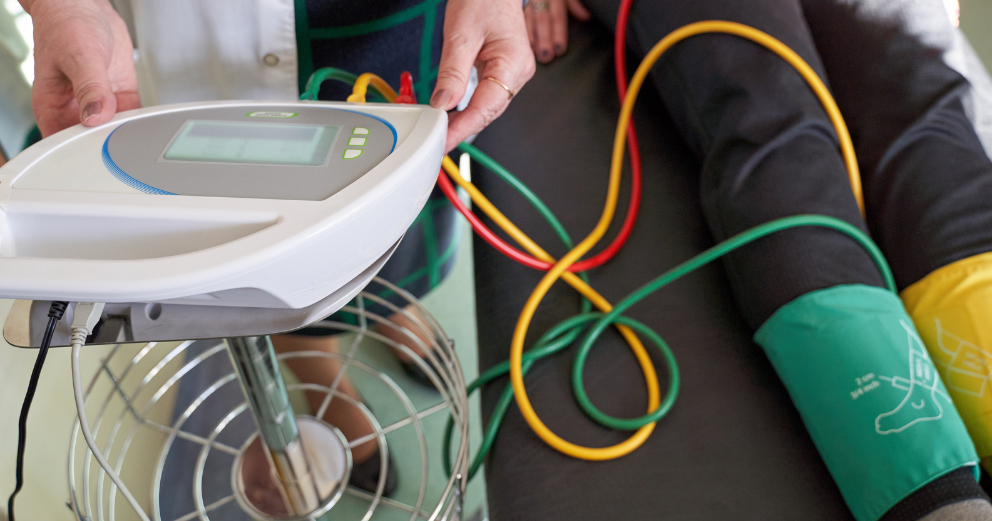
The ankle-brachial index is the primary non-invasive test for PAD. It compares the blood pressure measured at the ankle to the blood pressure measured at the arm. A ratio below 0.9 is diagnostic of peripheral artery disease. The test is simple, inexpensive, and can be performed in an outpatient setting.
When intervention is being planned, more detailed imaging is needed. Duplex ultrasound maps the location and severity of arterial disease. CT angiography and magnetic resonance angiography provide detailed anatomical information about the arterial tree and help the vascular team determine the most appropriate revascularisation approach.
Treatment
Timely diagnosis and proper management of peripheral artery disease, including coordinated care from a multispecialty team, are essential to help prevent amputation and other cardiovascular complications and to allow patients with PAD to live longer lives with better physical function and improved quality of life.
Treatment operates on two levels simultaneously:
- Cardiovascular risk reduction
All patients with PAD require aggressive management of the underlying risk factors driving atherosclerosis. This means tight blood glucose control in diabetics, optimal blood pressure management, cholesterol treatment, smoking cessation, and an antiplatelet agent to reduce the risk of cardiovascular events.
- Improving leg blood flow
For claudication, supervised exercise therapy is the most evidence-based first-line treatment for improving walking distance and quality of life. For patients with claudication, referral for supervised exercise training is recommended alongside risk factor modification.
Revascularisation operations are recommended when there are severe symptoms or when symptoms do not respond to exercise and medical management. Endovascular procedures such as balloon angioplasty and stenting are favoured when technically feasible due to the fact that they are less intrusive and have a lower procedural risk than surgical bypass.
For more complex arterial illness, bypass grafting with the patient’s own vein or a prosthetic conduit restores blood flow around the blocked segment.
For chronic limb-threatening ischaemia, urgent revascularisation is required to save the limb. The approach is determined by the anatomy of the disease and the patient's overall fitness for intervention.
Takeaways
Peripheral artery disease is a common and frequently underdiagnosed condition driven by atherosclerosis of the leg arteries. PAD symptoms range from claudication during walking to rest pain and non-healing wounds in more advanced disease.
The condition signals elevated systemic cardiovascular risk and requires both claudication treatment and aggressive cardiovascular risk factor management. Peripheral vascular disease diagnosis begins with the ankle-brachial index and is confirmed by imaging when intervention is planned.